We had an interesting discussion in “TROM Discussions” about the following video:
ALEX: For the upcoming discussion on politics/democracy, have a look at this interesting movement in Australia: voteflux.org
TIO: Hey, I’ve read their paper in full. So as I understand they want to move from voting for a political party to voting for specific projects. Also they want to let people trade votes with each other. On top of that, as I understand is like this: government gives each people one vote for one project; they can use or not this vote or they can trade it (but are not allowed to trade for money for example). If I understand all of this correctly, then I see a ton of issues with it. There are so many ways to make this system completely corrupt. I am wondering what is the difference between voting for a political party and voting for a specific project in terms of corruption? Aren’t both as corruptible? Aren’t people already influenced to vote for a particular political party? Couldn’t they influence people to vote for a particular project then?
I like that they mention decisions should be taken by experts (science), but I can see this system being easily corruptible, even scientists are corruptible. I still think that whenever there is a profit motive, it will ruin any system put in place. In other words: you just can’t make the trade-society (system) fair/just through rules, voting, different political parties, etc.
Let me know your thoughts.
ALEX: I’d say that when it comes to abuse of power by a few, the more people participate in democracy, the harder it would be for a few to abuse power because the power gets distributed. The more people that are engaged in developing policies, the less concentrated power is. When people delegate their power to a select few, it gets concentrated and more likely to be abused.
When it comes to corruption, again, I think the more people take part in democratic processes, the more aware they become about what’s going on, the less likely those in power would get away with corruption. The more politically active and aware people, the harder it would be to bribe / coerce everyone, values like honesty, transparency, accountability etc. would be easier to promote and to enforce
I’ve been thinking why I find it hard to accept that trade is the ‘root of all evil’ so to speak. I think it’s just a construct that reflects something deeper. After all, we are social creatures and we trade one way or another – with money, physical objects or with lots of other things like emotions, etc. You can’t eradicate that, it’s nature – we’re basically different elements coming into contact and thus interacting, this usually leads to some exchange. If you wanna abolish trade, you have to abolish all contact. Or perhaps I don’t fully understand what you mean by ‘trade’?
Or do you mean ‘profit’ instead of trade? That would be hard to define because I don’t even believe altruism exists. For example, when we do / give something without getting anything in return, we still get something in return – it could be feeling good about ourselves, it could be fulfilling a need to contribute to our society, to support people in need etc, but we’re still getting something in return in this ‘trade’. You can’t eradicate that.
And how do you define ‘profit’? Getting more than what you gave? That’s easily quantifiable when it comes to money but not so when it comes to other things.
Ultimately, I think it comes down to values. I think even profit (which can basically be compared to ‘growth’) can work fine as long as it’s in line with other values like kindness, sustainability, etc. The problem is that on our planet right now it’s not.
And regarding your q’s on VoteFlux: people voting for projects / issues is much better than voting for a party because once you vote for a party, you have to basically accept that party’s position on ALL the issues / projects and they may differ from yours. You can still delegate your vote (cos voting on every issue / project might be too onerous for people) but you would be delegating to an expert, rather than your elected politician, who is often not an expert and doesn’t often consult experts, or consults those who tell him/her what he/she wants to hear.
Plus, it’s common that a party may even have a specific policy that you agree with and hence vote for them, but politicians have often been known to change their position after being voted in, not to keep their promises, etc. And, most likely, you won’t find a party/politician whose policies/positions perfectly match yours, including new things that come up during the politician’s elected term.
TIO: Ok. But then how is it that currently millions of people are influenced though social media (or other means) to vote for a particular political party? To me that clearly shows that you can indeed influence a lot of people at once (regardless for what). On top of that, regardless of how many people are engaged in political decisions, in the end a few are taking those decisions (from architects to those who sign the contracts, company leaders or whatever) so there will always be weak links in the chain.
Apple was a dickhead many times with the users (slowing down phones intentionally, making their devices very expensive, removing necessary features from their phones, etc.). People got very angry at Apple. They could “vote with their wallet” and boycott Apple. This never ever happened. Is there an example of boycotting working? I think that is one big example of how, although people could “vote” in large numbers (with their wallets) and having in theory an immense power, this never ever happens. Apple knows how to persuade people to still buy their stuff, and also Apple is so powerful and big that it can bribe pretty much anyone. Celebrities, newspapers, TV channels, can all influence opinions in mass. I know when there are online voting campaigns for all sorts of stuff, and they too can are corrupted if there is an interest. People vote for their own interest most of the time anyway, so that combined with them begin also influenced, cannot lead to much progress I think.
That being said, I just cannot see how people voting for projects rather than politicians is not going to be influenced by companies, political parties, campaigns, and such, the same way they are now.
Not to mention that the vast majority of people know near to nothing about any important decision. They are normal workers who spend most of their time working at their job. How are they going to know what decisions are better and which ones are not?
So I still see 2 huge issues with this:
1. any system gets corrupted when the game is to acquire – if I am FIFA and want to host World Cup in Australia and there people vote per project, then I have a huge army of tools to make Australian people vote for us to host it there, and that would entitle building stadiums instead of hospitals and what not. If I am a political party and I want to cut the retirement money by 20% you bet I can convince many that it is a good idea. Again, such things happen today with elections all the time.
2. even if democracies would work 100% and would be non corruptible, relying on the “wisdom of crowds” is a very naive idea in mi own view. Regular people are not experts. Science doesn’t work that way.
And being able to trade your vote….to me that sounds like the perfect loophole to create a huge chain of corruption and cheating. You may give your vote to an expert, but what stops me to give it to a corrupt party when/if they will persuade me to do so? Or a corrupt expert that fools me into giving him my vote?
Maybe this system would be better than what we have now, but I really doubt it. Big companies and political parties have been lying to people and experts for the past 200 years and have been influencing them, so I don’t think they will stop doing that in a participatory democracy or the system you linked to.
I wish it was that simple, but I know too many examples of such ideas that ended up worse than what they replaced, being hijacked for profit by everyone. I just can’t see how you can stop people seeking for profit at any cost.
In regards to trade I think you got it wrong :). Of course we don’t talk about the scenarios you mentioned. When you help someone and get a reward in return like personal satisfaction, that’s just you feeling satisfied with your own action. Nothing to do with trade. You asked for nothing in return. I mean if you ask the other human being to massage you instead, that might be an obvious trade if you don’t help him without that massage :). We are talking about the obvious trades though. Think about money, that’s the biggest representation of trade. You can stop at that if you want. If not, think about any other currency (like cryptocurrencies). These are trades. You won’t get food in this world unless you pay for it. You won’t get medical attention unless you pay for it or are part of a tribe and respect its rules. Or the fact that FB wont let you use their service unless you give them your data – that’s like the massage idea. So if you help someone and feel good about it we can’t call that trade, no more than going to pee and feeling good afterwards and calling that a trade :). One example of an organization that removes the trades (not sure if entirely but that’s besides the point) is Doctors Without Borders. If they go to Syria to provide medical help they ask for nothing in return: no money, no massages, nothing. And they don’t care if you are a terrorist, you are from Syria, Iran, USA, are male or old. That’s a kind of system that I would call “trade free”. I hope it makes more sense now, if now I would be glad to try and explain more ;).
oh and 1 more that i forgot: 3. someone has to propose those projects, so that’s another loophole in the system. companies already bribe politicians to push their agenda (like pushing their projects to make profits), so how can you stop that? someone has to propose building new roads, a new chain of hospitals, or privatizing healthcare. and those who propose can be very easily bribed or have vested interests of all sorts.
ALEX: Ok, hold on, I’m not sure I understand – Doctors Without Borders still have to eat, so how do they get their food unless they grow it themselves? It’s basically indirect trade – they do something ‘for free’ and farmers grow food ‘for free’ but ultimately, the Doctor can benefit from the farmer and the farmer from the Doctor, that’s trade to me. So you’re against direct trade then? You’d like everyone to just do things to benefit others without expecting anything in return?
If that’s so, then how would you have a fair society? It will be impossible for everyone to contribute equally, so you get the old ‘each according to their ability, to each according to their need’, this is good in theory but is flawed in practice – because people rarely make an effort according to their full ability and people’s needs are rarely ‘equal’. So you’ll end up again with a society where some exploit others.
Plus, I still would argue that nobody ever does anything ‘for free’, they do it because they expect others to do it too so that they ultimately benefit from their input, indirectly. Plus, the altruistic system only works if EVERYONE is altruistic, which I don’t expect in practice.
Regarding the ‘wisdom of crowds’, there’s a good book by that name, I recommend it!
Also, I see where you’re getting at with ‘people will still be manipulated by the rich/powerful interest groups’.. ok, yes, that’s a problem, but I think that a participatory democracy or what’s proposed by Flux basically makes it MUCH more expensive and harder to manipulate people. E.g. politicians currently have to manipulate people before every election, they can sort of get away with most things during their term, people have short memories. That’s unless they fuck up so badly that they get voted out because of it. We had this happen with John Howard and his Work Choices policy, which alone got his party voted out.. but that’s rare nowadays, whereas here politicians/lobbyists would have to spend much more effort/money to manipulate people or experts in a more direct democracy. Whatever increases this ‘costs’ for them, in my opinion, is good to achieve some changes.
TIO: Doctors Without Borders are volunteers. They get donations/gifts but do not do the work for that reason, that’s why they are called volunteers. It would be a hell of a job to go to Syria and help others for just eating and getting some support for your deeds. Better stay in France and work in a hospital for those kinds of “benefits”. This is why they are volunteers.
Benefits do not equal trade – benefits can be extracted from trade, but they can exist without trade. I may discover a vaccine that cures cancer, and I do that because I am passionate about it, and that will benefit 1 billion people, but I asked nothing from them, thus there was no trade. Pasteur or Marie Currie worked their entire life on solving problems or discovering, and many have benefited from their work without trading anything to them for that. They just did it for whatever reasons (mostly because they loved doing it), and the benefit came as a result of that.
What I propose is to remove the need for trade. You want food? You should be able to get it without you giving anything in return: money, data, being straight or white (if they ask for such things), etc.. That’s the basic idea that we can expand to other areas. It cannot be 100% perfect at all. This is what I am trying to explain with the current book I am working, but if you think about it I propose nothing new. Many charity organizations are in a sense trade free: they work as volunteers and they rarely discriminate. Meaning they will help poor people regardless of where they are located, or who they are, and they don’t ask these people for money, their data, to sing a song or dress a certain way. Not sure if I make my point go across, but that’s what I am proposing on a global scale. It is a form of volunteering combined with charity combined with non for profit.
Examples of trade free systems:
1. Wikipedia: you use it without giving anything in return. You can edit articles, write, copy them, access them from anywhere.
2. Linux: it is free and open source. You can use it, distribute, edit, share, etc.. They ask you nothing in return.
And examples of trade systems:
1. Everypedia: they may mine your data, they may project ads into your face, they may put their articles behind paywalls. So they are in a trade with you, you can’t access their system for free, as in “trade free”.
2. Windows: you have to pay for it to access, you cannot edit the code or share, and so forth.
I will provide more examples in the current book in more detail, but I am yet to reach that part.
Thanks for the book recommendation, I have heard of it, even saw a documentary based on it. I agree with the wisdom of the crowds idea, but I think it can be best exercised in a trade free society, else the need for profit is going to ruin the “wisdom” part of the crowds. I think yes, people should try such ideas like the one you proposed, but I also think there should be some of us who think bigger than that. Maybe at one point we can become intertwine. Thanks for participating in such discussions Alex.
PABLO: btw, Tio Trom just a small point about the “Doctors without borders” and the general discussion topic. Volunteers actually do receive a “benefit” from their works…and that’s the “good feeling” of helping someone or something in need. That’s a physiological reaction from an action which stimulates the dopamine system of our bodies (as every other action we do) and in that sense its no different from any other “selfish” or “profit based” action (the only thing that changes is the subjective reward in the first case). So in a way you can make a point that is also a way of “trade” (a really indirect one because even if its personal, there is an interaction with an external party involved) in which you exchange your time and skills for a personal gain (although again, with no apparent external benefits for you). Of course, that’s an extreme example and probably you can make an argument whether is it even possible to find a “not selfish action” at all in real life (which I think is almost impossible considering that we all have hidden motives the we’re not even aware about it). And of course, not many people (me included) are going to tell you that altruism is a selfish or a “bad” action. In fact, I think its really easy to argue that is the basic of the development of our human society (trait we share with another social animals like apes and insects, etc) but I wanted to point it out because if you really want to make a point about the possibility of a “no trade system” and use examples of altruistic behaviour (like the ones you pointed out), one of the many things you would have to address is the problem of unfairness of that system, when there are people in the system who are not “altruist” or are even worse (because lets be real, not many people would like to go to Syria to help others). I think that’s the point Alex Shly wanted to make about that. Of course, that’s just an opinion and I may be wrong, but if that’s the case, I don’t think that’s the biggest problem of the “no trade system” at all. But I don’t think my problem with the “no trade system” can be addressed with just a facebook comment (and that’s why I’m not doing it now). I think it goes far beyond that, to the discussion about human nature in general and I don’t think we are even close to resolve that. So, for now I think every single one of your ideas (and mine too) are just that…Ideas with a different rate of “success” depending on economical, social and natural environmental factors (which we obviously dont’ know because we don’t even know what is success). But because they’re just ideas, we all have arguments for why one is better than the other and that’s why we’re here in this group, right?…btw..I support democracy…and I’ll try my best to defend it in tomorrows discussion
TIO: Volunteers are not a different species or a particular group, volunteers are humans and what they get in return for their action is up to them. Who knows what that is….maybe they do it for religious reasons, maybe just because they want to (nothing more than that), maybe because they are selfish and want to do that, and so forth. I work as a volunteer for the past 12 years creating documentaries, books, videos, and so forth. Ask me what I get in return because I can’t tell you. I get nothing. I just do them because I enjoy doing them.
You can’t say the following two actions are the same in the sense of trade: I go to help my friend fix his computer – I ask for nothing, but I feel good about doing that. I go to help my friend fix his computer – I ask for money (or his bike for a ride) or else I won’t do it. You can’t call those personal trades, no more (as I explained to Alex) than going to the bathroom to pee and feel good afterwards and call that a “trade”: you went to the bathroom to pee because it felt good.
Why do people play football with friends? Why parents are good with their children? Why would you watch movies? Why Why Why? Is this all because you are selfish and want something in return? If so, that’s a sad life, but is up to you. As long as you don’t engage in trades with others that’s fine :).
We can imagine a society where most people are volunteers, and thus do not engage in trades, and we rely on them. Today if all volunteers would stop doing their volunteer work our global society would collapse. When there is a natural disaster we rely on volunteers. The Internet as a whole emerged out of volunteers who created (and still create) content for nothing in return. The entire scientific field is based on volunteers who discovered and even experimented on their own (if you want a bucket of examples I can send you). People already rely on Doctors Without Borders or Red Cross. And since we can automate pretty much any job, a sane society (trade-free) would only rely on a few volunteers to run.
Here’s a video we made about the future of education and you’ll see many examples of volunteers in there
A book about motivation and cooperation
A book on volunteering
A book on how to automate pretty much all jobs
In such a system there can’t be unfairness because people are not valued by their contribution.
There is no human nature out there [Link 1; Link 2]- it is only human behavior that is created by the environment. Maybe we should do a discussion on that. My ideas are sourced though :) – that’s a big difference. I don’t just think about these things at night and talk about them. All of our books are sourced and we are here to take in any valid criticism
TASOS: Alex, if by using updated technology, we as a species, can create today an abundant society giving free access for all people’s needs then why we need trade?
Trade as we all know guides to competition-profit-personal enrichment-comparative advantage-conflicts-violence-racism and so on…
Also, why we should try for something better (inside of the current system’s box) instead to demand for the best we definitely can have today?
YOAN: Hi guys!
After reading the conversation I’d like to give my thoughts on a few things :
– I don’t think we always get something back when we do something but it also seems to me that we always do something when we think we’re going to get something back in return. Or to say it differently, it seems to me that we are all fundamentally selfish, and everything we do, we do it for ouselves, thinking that we will benefit from it.
This is of course my thought on a topic where, to my knowledge, Science doesn’t have an answer yet, as it is really hard to create experiments that will give clear answers about this.
That also makes me agree entirely with the environment shaping behaviour, because what is going to give me pleasure, or what is going to motivate me ultimately will be shaped by my environment (Something that Science knows already more about).
– I don’t think we should try to say “trade is this”, or “we can’t say that this is trade”, but I think we should all have the same definition of trade while talking about it, and whatever what we think trade is, for this conversation it can be something different than in our everyday life. What matters is that we all have the same definition while talking about it.
So obviously even peeing and getting satisfaction CAN be considered as a trade by some, but I think on this group we should try to stick with Tio’s definition, as every book is based on this one.
And the problem that we see in our current society is that we live in a trade based system. I don’t know much about “human nature”, but I agree with Alex if he says that we can’t remove trade among humans (if we consider trade as an “exchange” here). According to me, TROM is not fighting against trade, it is fighting against the need for trade, and maybe the “trade mentality ” of the people that make them feel like they need to exchange things. TROM is not trying to create a society where trade is bad… If we reach a society like what TROM proposes (or let’s say a RBE, sorry it’s just more simple to write :p) and you give me something, I won’t be like “oh sorry I can’t give you anything now because trade is bad” :p.
The difference is the need for trade.
if you give me something and I give you something, this is not seen as a problem, but if I give you something only because you gave me something, then that’s a problem.
I wrote that from my phone, it’s a mess, sorry, but I don’t feel like improving it, I didn’t plan to spend so much time on this haha
I hope it makes a bit of sense.
Maybe I just talked bullshit, but my point is : agree on your definitions before you start wasting time :p
it’s not about who has the right definition, but what definition do we choose to keep going in our conversation
TIO: Yes Yoann you put it very well. The reason I say “trade or the need for trade leads to problems” is because there are trades without money. I am saying the same thing everyone said for the past hundreds of years: “money is the problem”. I only go a step forward to include more systems similar to money like cryptocurrencies, data trade, etc. I will explain this in the current book I am working on in detail. When there is a trade or a need for trade it means some have something that others want or need and they can’t get it without. Is that simple. An imbalance that creates issues.
We can’t go as nuts :) as to include things like: “I help you because inside I feel well about that” and call that trade. That is absurd. If you do that with any idea you will lose your mind :)). It’s like saying democracy is about voting what music people should listen to, or voting when we should pee. Of course no one goes to those lengths and crazy edges. ;)
If in a saner society where we have most of the stuff we need or want, I come to you and say: “Please give me some cookies” and you say “Only if you give me a massage” then that’s an issue because it means I can’t get cookies if I won’t give you a massage. That’s a trade. Maybe I can accept to give you a massage and you will give me cookies, and everything will be fine, we are both happy, but it is a very slippery slope. It means there aren’t enough cookies for us all and it also means this gives you the power to abuse me. Maybe next time you ask me for some weird shit, who knows. That’s all.
Therefore, eliminated this virus “trade” that makes people do shitty stuff, and you indirectly will create a society based on abundance, something like the venus project talks about. Same idea, different paths.
SASHA: I would like to add a personal example here to demonstrate the benefits of a trade free system-
To survive on planet Earth, I have to work for money- I have to trade my time, energy and skills to get money, with which I can then buy the stuff that I need. I do this for a short period of time and then live and travel on my savings for as long as possible (then I repeat again). I hate those moments when I have to work for money. There have been many of those months where I was unhappy and unsatisfied. Earlier in my life I would be confused in these moments- what was I doing? What was the point of this? -I didn’t have a good understanding of our environment (the system we live in). When I was forced to work and study subjects I cared nothing about, I became depressed. I remember an ex-boyfriend telling me that I was unhappy because I was thinking too much about myself. I realized that that was true, and I wanted to help others and thought that that might help me in return, but I wasn’t able to do that without fixing my own problems first. So when you’re forced to trade your skills and energy for money, by doing a task that you don’t enjoy, this can very likely lead you down a slippery slope that would hinder your ability to help others. Why don’t more people volunteer? They’re too busy trying to survive in this system, or trying to fix their own problems (which are a consequence of this system).
So now I’m in this time period of my life where I’m just living off of my savings. I saved money the last time I worked and now I don’t have to waste my time trading my skills to get the stuff I need to survive with (until I run out of $ again). Basically, my needs are covered- like what would be the case in a trade-free world. So now I can do what I want!
This- having my needs covered- plus education (understanding my environment)- has brought real happiness and satisfaction to my life. I’m so stoked to be alive right now! I can’t sleep well at night because I can’t wait for the next day to start! I wish I didn’t have to sleep! :D I get up every morning with excitement. And now, what do I want to do with all of this free time that I have? I want to help others! I don’t need to concentrate on myself anymore, now I can work on something much greater!
I didn’t start my blog to get money or some extra personal satisfaction. I’m already satisfied, really. I’m genuinely writing it because I hope that it can help people. Same reason I help with TROM and TVP. Same reason I would help a friend if they were hurt. This is not trade- definitely not the kind of trade that we’re talking about in TROM.
To put it short, we could progress and help each other so much more if we weren’t forced to trade our skills and energy for our needs.
TIO: Well said! :) – If we weren’t forced to trade our energy and skills for our needs, we would share our energy and skills to help others, to improve society, ourselves, and so forth.
Don’t trade your energy and skills, share them ;)
You Sasha can and are able to inspire others to game the game, like you do. So thank you for being you!
SASHA: Thanks Tio, I can definitely say the same thing back to you- thank you for being you :) You’re my biggest inspiration for what I’m doing now, I hope you know that
And you see how that can be a positive spiral- people helping others- this inspiring others to help other others :), rather than people competing and wasting their energy on trying to survive and simply improve their own lives.
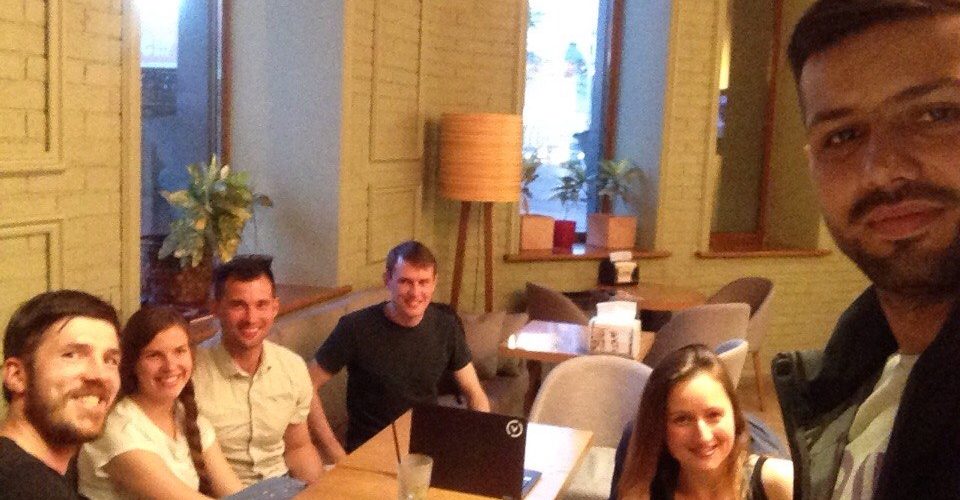
From TROM Discussions :)